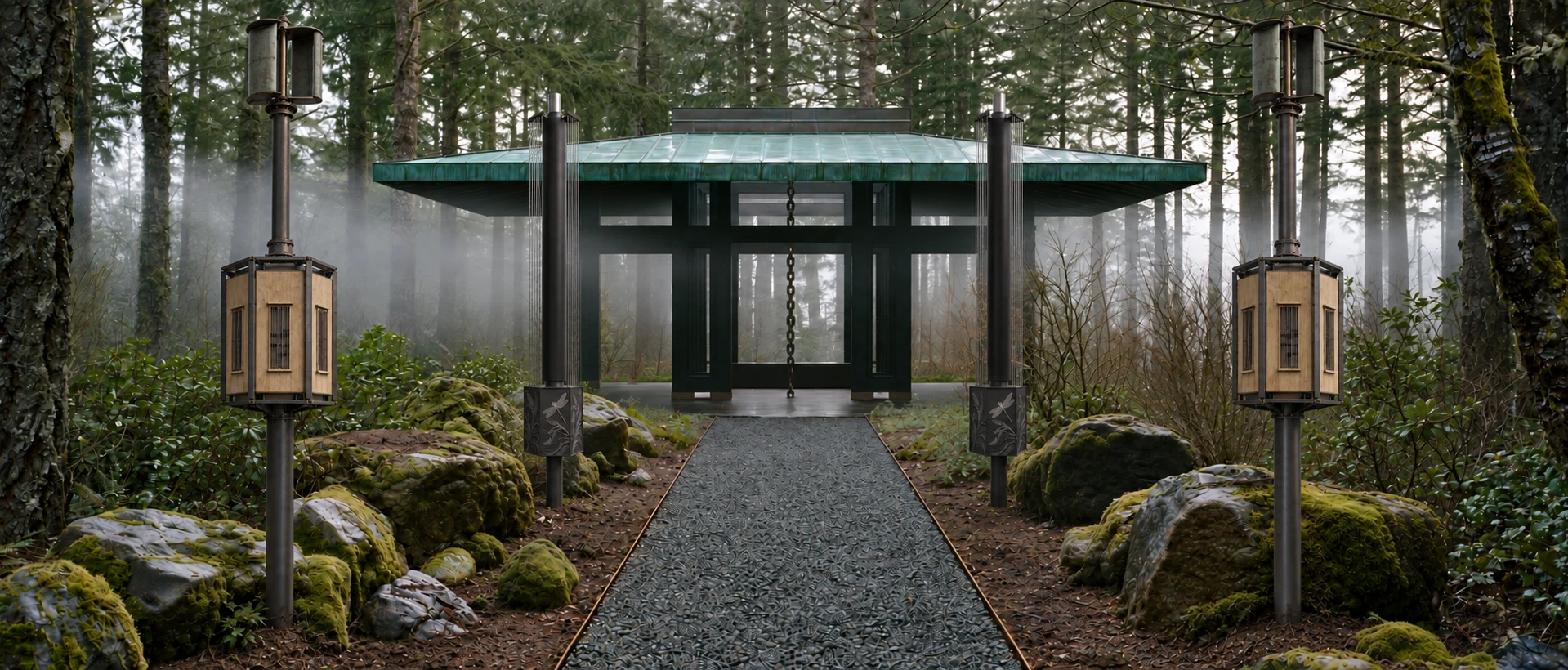
A coastal listening pavilion framed by wind-played poles
Study

Outdoor sound works · Pacific Northwest coast

Aeolian
Suikinkutsu

Weather-played instruments for the rain, wind, and dense coastal fog of southern Vancouver Island.

Enter the work ↓

Visitors approach a central listening pavilion through a changing acoustic field. Pacific weather supplies the score; material gives it a contemporary voice.

Weather becomes
the musician.

Artists Oliver Hockenhull, Peter Courtemanche, and Keiko Honda are developing a family of outdoor sound works for gardens and ocean bluffs along the Pacific Northwest coast.

The project is being developed for the distinctive weather of the south coast of Vancouver Island: rain, changing winds, and periods of intense coastal fog. These conditions shape the instruments’ construction, water collection, and acoustic response.

These instruments bring the Japanese suikinkutsu—a water-koto cavern sounded by falling drops—into conversation with aeolian harps, pipes, and strings played by wind. Quiet but not silent, they create durable places for listening, meditation, and curiosity.

See forms and scales →
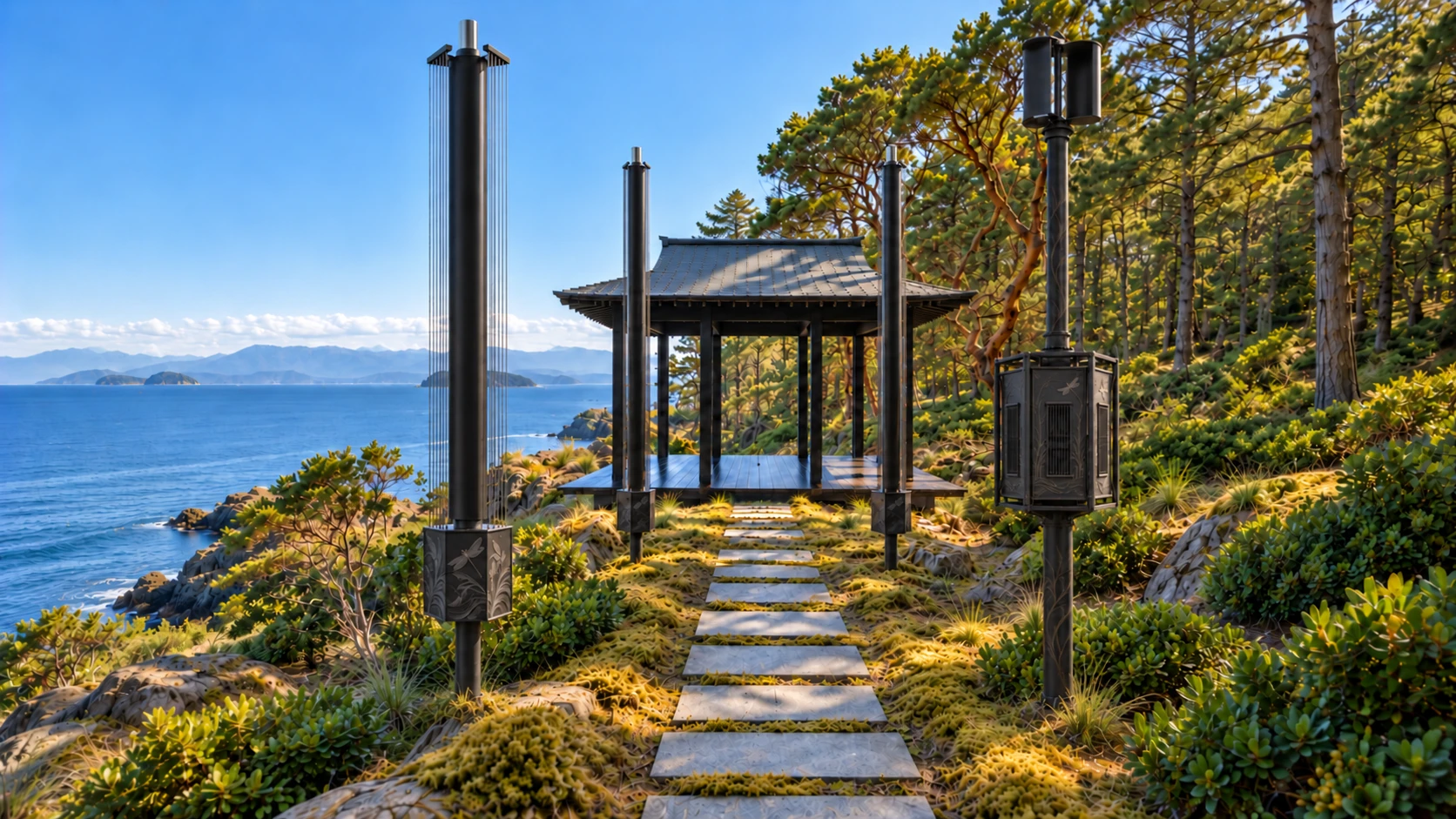
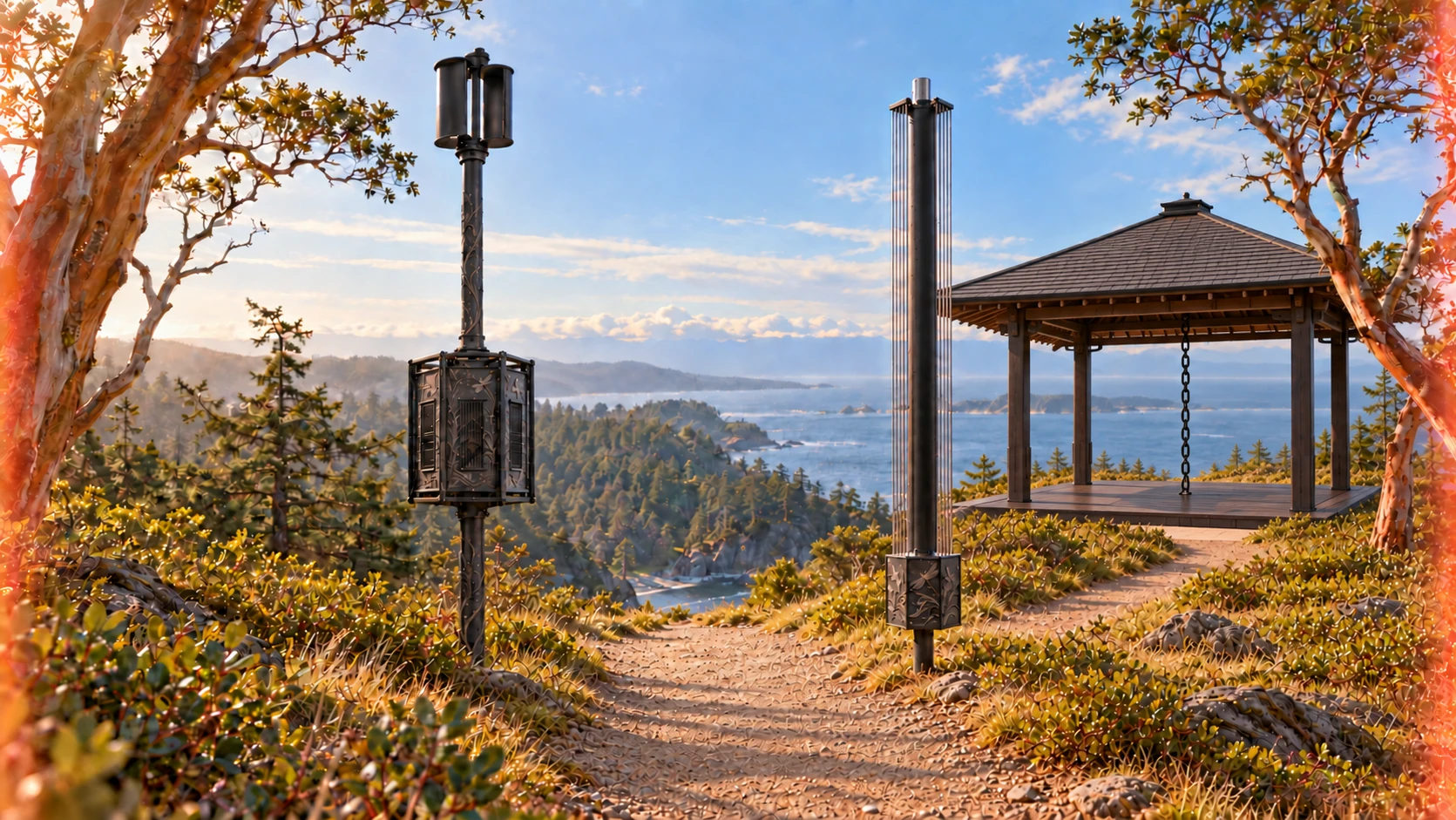
Stone path through coastal landscape and vertical wind-played poles
Wind field study · coastal approach
Updated garden pavilion concept with wind-driven strumming instruments

The listening pavilion

At the centre,
a quieter weather.

The pavilion gathers wind, rain, material, and attention. A redesigned kusari-doi—a rain chain—guides water toward a buried resonant vessel. Below the floor, isolated drops arrive in a shallow pool and the suikinkutsu answers with a deep resonating tone.

The architecture is a threshold: from the broad acoustic field of the coast to a sound discovered by leaning in.

Read the Suikinkutsu page →

A living garden
carries history.

Aeolian Suikinkutsu is informed by the Japanese tradition of the water-koto cavern: a practice of hidden sound, garden attention, and material care, and equally by the ancient aeolian harp of the west. It approaches these traditions and these instruments as living—not as an aesthetic shorthand—and develops new forms through invitation, consultation, and site-specific listening.

On Vancouver Island, Japanese and Japanese Canadian gardeners shaped important gardens before dispossession and forced removal fractured communities in 1942. The island holds several significant Japanese gardens, including Gorge Park, Hatley Park, and Butchart Gardens; UBC’s Nitobe Memorial Garden is one of the most extensive and acclaimed Japanese gardens outside Japan. The project holds this history alongside a contemporary global acoustic play: how might distinct eastern and western natural acoustic lineages meet here and inform one another?

History and listening practice →

From a quiet corner
to a gathering place.

Scale

Site-specific forms

A compact instrument might occupy no more than three feet square, with planting or vines growing around it. A larger version could become a twelve-foot pavilion: shelter from the rain, a listening room, and a place to gather for tea.

Events

Interest through encounter

The works can become the focus of tea performance, tea ceremony, sound and music, talks, listening sessions, and gatherings related to green space—bringing new audiences into an existing garden.

Collaboration

Designed through consultation

The artists work with people who care for outdoor spaces. The aim is to make each work belong to its setting, enhance the garden’s own vision, and invite visitors to notice both the instrument and the place around it.

Interactive study

Explore the instruments.

Interactive design studies of the aeolian harp and wind-driven strumming instruments.

View 3D studies →

A garden conversation

What might
sound here?

For curatorial conversations, host-site exploration, and funding enquiries.

Who we are →